ULTRAMAN (aka ULTRAMAN: THE MOVIE) Japanese Title: ???????????? (Chouhen Kaiju Eiga Urutoraman) Literal Translation: Feature Length Monster Movie: Ultraman
Release Date: July 22, 1967 Running Time: 79 minutes Aspect Ratio: 1.375:1 (Academy) Production: Tsuburaya Productions Co., Ltd. Distributor: Toho Co., Ltd. Executive Producer: Eiji Tsuburaya Producers: Toshiaki Ichikawa, Masami Sueyasu Director: Hajime Tsuburaya FX Director: Koichi Takano Writers: Shinichi Sekizawa, Tetsuo Kinjo, Shozo Uehara, Bunzo Wakatsuki Cinematographers: Yasumichi Fukuzawa, Masaharu Utsumi Music: Kunio Miyauchi Cast Shin Hayata: Susumu Kurobe Captain Toshio Muramatsu: Akiji Kobayashi Daisuke Arashi: Iyoshi Ishii (Sandaiyu Dokumamushi) Mitsuhiro Ide: Masanari Nihei Akiko Fuji: Hiroko Sakurai Ultraman: Satoshi "Bin" Furuya Hoshino: Akihide Tsuzawa Matsui: Akio Matsumoto Dr. Nakatani: Kotaro Tomita Osamu Suzuki: Chiharu Inayoshi Policemen: Hiroshi Kuni, Kozo Watanabe Monsters: Teruo Aragaki, Yukihiro Seino, Umenosuke Izumi, Shuji Fujita Narrators: Koji Ishizaka, Mitsu Urano
Story: From the depths of space the heroic alien Ultraman from Nebula M78 pursues the evil monster Bemular. Entering Earth`s atmosphere, Ultraman`s travel sphere accidentally crashes into a jet piloted by Hayata, a member of the worldwide investigation and defense organization called the Science Patrol (Science Special Search Party). Hayata is killed in the impact, but Ultraman is able to revive him by combining their life forces. The alien gives Hayata the Beta Capsule, a device that will allow the Science Patrol agent to transform into Ultraman in times of need. The other members of the Science Patrol arrive at the crash site in Ryugamorii and join Hayata in a plan to defeat Bemular, who has taken refuge in a nearby lake. Captain Muramatsu leads an aerial assault aboard the Patrol`s Jet-VTOL while Hayata strikes from underwater with Submarine S16. The combined assault quickly destroys the monster. Contact is lost with a scientific research outpost on remote Tatara Island in the Pacific. The Science Patrol is sent to rescue the stranded scientists but instead finds the island is overrun with the giant monsters Red King, Chandlar, Magula and the carnivorous plants Suflan. With the help of the friendly monster Pigmon, the Patrol finds Matsui, the sole survivor on the island. But before they can get to safety, Red King appears and kills Pigmon. Hayata turns into Ultraman and makes short work of Red King.
Arashi of the Science Patrol joins an expedition to the Johnson Islands where they discover the giant subterranean monster Gomora. At the request of Dr. Nakatani, the Science Patrol sedates Gomora and airlifts it to Japan for study. But the monster revives while en route and the Patrol is forced to cut it loose before Gomora can pull their planes from the sky. As the enraged creature goes on a rampage, Ultraman suddenly appears. The two fight, but Gomora is able to escape underground after knocking Ultraman senseless with strikes from its whip-like tail. Ultraman also loses the Beta Capsule during the battle, meaning Hayata is unable to transform again. The Beta Capsule is found by Osamu, a young boy obsessed with monsters. Osamu returns the device to Hayata, who becomes Ultraman for the final battle with Gomora at Osaka Castle.
Notes: With the tremendous success of ULTRAMAN on television, a movie was an obvious next step for the franchise. So, while the show was still airing on TBS, Tsuburaya Productions began developing a theatrical spin-off. The task was assigned to Toshihiro Iijima, a director and writer on both ULTRA Q and ULTRAMAN and the man responsible for the first two appearances of those fan-favorite Ultraman villains, the Baltan aliens -- ULTRAMAN Episode 2- BLAST THE INVADERS (??????, Shinryakusha o Ute), and Episode 16- THE SCIENCE PATROL IN SPACE (??????, Katokutai Uchuu e). Iijima wrote a feature-length screenplay entitled ULTRAMAN: OPERATION GIANT (???????????????, Urutoraman: Jaianto Sakusen) which set Ultraman and the Science Patrol against multiple menaces. The story introduces the robot `Napoleon`, a machine created by the scientist Professor Watanabe to supervise and provide maintenance at construction facilities. Designed to operate without the need for human assistance, Napoleon was given an extremely high level of intelligence. Even so, the robot was eventually surpassed by newer and more efficient models. Scrapped by it`s makers, Napoleon declares war on humanity.
From a hidden location, Napoleon announces that it will awaken the subterranean monster Molgo, currently hibernating in northern Mongolia. The Science Patrol splits into two groups, with Captain Muramatsu, Fuji, and Ide heading to the Northern Alps to take action against Molgo while Hayata and Arashi search for Napoleon`s whereabouts. The deadly robot is found, and soon reveals the horrifying truth to the Patrol agents... There are no less than five separate forces at work to conquer the human race and the Earth. Once mankind has been dealt with, these forces will fight amongst themselves to decide who will rule the planet. The name assigned to this horrific final, apocalyptic battle is `Operation Giant`. Hayata and Arashi are able to defeat Napoleon, who leaves behind an ominous warning that the Baltan armada is coming from the far reaches of space to participate in Operation Giant. Meanwhile in Mongolia, Muramatsu and his team put a stop to Molgo. But no sooner does the Science Patrol return to headquarters then they have to deal with another potential threat. On Ocarina Island, the Steel Giant G -- a 50 meter tall statue of a warrior clad in western medieval armor -- has reportedly vanished! Just where did this giant disappear to... and is G one of the five menaces Napoleon spoke of? ULTRAMAN: OPERATION GIANT was clearly written for the big screen, with a much larger scale than could be accomplished on the ULTRAMAN television series. The film would have been a
huge undertaking for TPC and TBS, and budgetary concerns were reportedly the core reason that plans for OPERATION GIANT were cancelled in the early stages of pre-production. Toshihiro Iijima`s unproduced screenplay was later included as a bonus item in the complete
Official Magazine File: Ultraman collection released by Kodansha, Ltd. in July, 2005. That December, Kodansha also published the
Ultraman: Operation Giant novelization, written by Iijima under the pen-name Kitao Senzoku, and illustrated by Noriaki Tamiya, an artist well-known for his packaging art from numerous Tsuburaya and Toho model kits. And Toshihiro Iijima would finally have an opportunity to direct his Baltans on the big screen with the movie ULTRAMAN COSMOS: THE FIRST CONTACT (Urutoraman Kosumosu: Za Faasuto Kontakuto, 2001).
After the demise of ULTRAMAN: OPERATION GIANT, TPC scaled things way back and opted instead for something much less ambitious (and expensive). Ultraman`s first theatrical appearance would simply be a compilation of four television episodes directed by Eiji Tsuburaya`s eldest son, Hajime Tsuburaya: ULTRAMAN Episode 1- ULTRA OPERATION #1 (?????????, Urutora Sakusen Dai Ichigo); Episode 8- THE LAWLESS ZONE OF MONSTERS ??????, Kaiju Muho Chitai); and Episodes 26 and 27- THE IMPERIAL MONSTER Parts 1 and 2 (????, Kaiju Denka). The stories were edited somewhat differently for the film version, most notably with space monster Bemular now being defeated by the Science Patrol rather than Ultraman. Much of the subplot involving the boy Osamu (Hajime in the English dubbed TV episodes) was removed from the Gomora storyline, keeping the focus on Ultraman and the Patrol. The first Ultraman film was theatrically distributed in Japan by Toho on a double bill with the studio`s own
KING KONG ESCAPES (Kingu Kongu no Gyakushu). An English subtitled version of the movie was also produced, and offered for international sales by Toho in 1967. Originally marketed simply as ULTRAMAN, Tsuburaya Productions now promotes the film with the English title ULTRAMAN: THE MOVIE. In Japan the film has been issued on VHS, laserdisc and Region 2 DVD. ULTRAMAN: THE MOVIE was never released in North America, though English dubbed versions of the individual ULTRAMAN episodes used for this film were distributed in the United States by United Artists.
ULTRA SEVEN Japanese Title: ??????? (Urutora Sebun) Literal Translation: Ultra Seven
Release Date: July 21, 1968 Running Time: 25 minutes Aspect Ratio: 1.375:1 (Academy) Production: Tsuburaya Productions Co., Ltd., Tokyo Broadcasting System Distributor: Toei Doga (Toei Animation) Executive Producer: Eiji Tsuburaya Producers: Toshimichi Miwa, Masami Sueyasu, Yoji Hashimoto Director: Hajime Tsuburaya FX Director: Jun Oki Writer: Tetsuo Kinjo Music: Tohru Fuyuki Cast Dan Moroboshi: Koji Moritsugu Commander Kaoru Kiriyama: Shoji Nakayama Soga:
Shinsuke Achiha Amagi: Satoshi "Bin" Furuya Anne Yuri: Yuriko Hishimi Shigeru Furuhashi: Iyoshi Ishii (Sandaiyu Dokumamushi) Counselor Manabe: Yoichi Miyagawa Ultra Seven: Koji Uenishi Narrator: Hikaru Urano
Story: During a routine parachute training exercise, Ultra Guard agents Soga and Amagi drop into a cloud and vanish. Commander Kiriyama orders a search for the missing team members.
Amagi awakens in a strange, fog-enshrouded forest. He is attacked by tick-like insects that leap down from the trees, and is observed by a giant alien creature. Hearing Soga`s cries, Amagi finds his teammate trapped in a bog and pulls him to safety. Later, they see the planet Earth appear in the night sky. The two radio for help, and their faint distress messages are picked up back at headquarters but are soon cut off by piercing sound waves. Terrestrial Defense Force Counselor Manabe recognizes the sounds and identifies their source as Alien Bell, a gigantic creature that can create a dimensional rift in the sky in which to capture its prey. Manabe recalls that a jet liner once flew into Bell`s "X Space" and was never recovered. Following Amagi`s beacon, the Ultra Guard races to the rescue in their fighter plane Ultra Hawk 1. They spot a strange looking cloud formation and fly into it, arriving in the other-dimensional forest just in time to save Soga and Amagi from some strangling vines and Gumonga, a poison gas spewing, man-sized monster spider. Commander Kiriyama and Anne take Soga and Amagi back to the Ultra Hawk while Dan finishes off Gumonga. Bell attacks, and Dan is nearly overwhelmed by its sonic assault but is able to transform into Ultra Seven and kill the alien. With Bell`s death the X Space begins to fade away. The Ultra Guard safely lifts off in Ultra Hawk 1 as the last of the X Space forest disappears around them.
Notes: Following the one-two punch of ULTRA Q and ULTRAMAN, Tsuburaya Productions and TBS next teamed up for ULTRA SEVEN, generally considered by Japanese fans as the best of the Ultra Series. Running for 49 episodes from October 1, 1967 to September 8, 1968, ULTRA SEVEN focused on the theme of `invasion` with a more serious science fiction tone than its often fantasy-like predecessors. The show clicked with viewers and was later revived in a pair of TV specials in 1994, a trio of OV (original video) series from 1998-2002, and the late night series
ULTRASEVEN X (Urutorasebun Ekkusu, 2007).
Special Agent 340, a cartographer from Nebula M78, visits Earth while on assignment mapping the movement of planets in the Milky Way. He witnesses a selfless act by a young mountain climber named Jiro Satsuma (Koji Moritsugu) who cut his own line rather than risk the life of a fellow climber. After rescuing Satsuma from certain death, Observer 340 decides to remain on Earth to learn more about mankind. The spacemen copies the likeness of Satsuma and travels Japan disguised as Dan Moroboshi (also Moritsugu). When Earth is threatened by alien invaders, Dan joins the Ultra Guard, the counterstrike unit of the Terrestrial Defense Force. In times of need, he uses his Ultra Eye goggles to transform back into his true self, now known as the honorary seventh member of the Ultra Garrison— Ultra Seven. During ULTRA SEVEN`s original run on television, Episode 18- THE BELLS ARE RINGING (??X??, Kukan Ekkusu Dasshutsu; literal translation: Escape from X Space) was also shown theatrically as part of the "Toei Manga Parade" (?????????, Toei Manga Pareedo). It`s co-features were all anime produced by Toei Animation Co... two episodes of the television series GEGEGE NO KITARO (1968), an episode of SALLY THE WITCH (Mahootsukai Sarii, 1966), and the main feature LITTLE NORSE PRINCE VALIANT (Taiyoo no Oji - Horusu no Daibouken, aka Prince of the Sun), the first film directed by Studio Ghibli co-founder Isao Takahata. Takahata`s future Ghibli partner Hayao Miyazaki also worked on LITTLE NORSE PRINCE VALIANT as a scene designer and key animator. The animated film was later dubbed in English and syndicated to television in the United States by American International Pictures as LITTLE NORSE PRINCE.
THE BELLS ARE RINGING is a noteworthy episode of ULTRA SEVEN in that Ultra Seven`s alter-ego Dan Moroboshi is able to transform at will without using his traditional Ultra Eye. Also, Ultra Guard member Furuhashi, a main character in the series played by Sandaiyu Dokumamushi (best known in the West as Arashi in ULTRAMAN), appears only in the opening scene and does not take part in the rescue mission. Dokumamushi went by his real name Iyoshi Ishii in ULTRAMAN and ULTRA SEVEN, but began using a stage name starting in 1968. In the early 1970s a number of Japanese tokusatsu shows were broadcast on television in Hawaii. An English dub of ULTRA SEVEN was created by Tsuburaya-Hawaii Inc. and the series (including Episode 18) debuted on KHON-TV Hawaii in 1975. A second dubbed version of the series entitled ULTRA-7 was produced by Turner Program Services, Inc. and shown on the American cable television station TNT (Turner Network Television) beginning in January, 1994. The episode THE BELLS ARE RINGING first aired on TNT on February 16, 1994 and was occasionally repeated until Turner`s rights to the show expired in 2000.
ULTRAMAN ?ULTRA SEVEN: GIANT MONSTER EXTREME BATTLE Japanese Title: ?????????????? ???????? (Urutoraman ?Urutora Sebun: Moretsu Daikaiju-sen) Literal Translation: Ultraman ?Ultra Seven: Violent Giant Monster War
Release Date: March 21, 1969 Running Time: 15 minutes Production: Tsuburaya Productions Co., Ltd. Supervision: Eiji Tsuburaya Producer: Hajime Tsuburaya, Atsushi Takayama Director: Kazuo Sagawa Writer: Shouji Ootomo Cinematography: Yoshihiro Mori Optical Photography: Minoru Nakano Music: Kunio Miyauchi, Tohru Fuyuki Cast Voice of Booska: Kazue Takahashi Voice of Chamegon: Ayako Hori
Story: An all-out action extravaganza hosted by the popular children`s monster Booska and his little brother Chamegon, who encounter over 40 aliens and monsters from the Ultra-verse. As Booska and Chamegon pursue the monsters across Japan, Ultraman and Ultra Seven appear to eliminate the invaders!
Notes: Showing from March 21st to May 31st in 1969, ULTRAMAN ?ULTRA SEVEN: GIANT MONSTER EXTREME BATTLE was created especially for the Circlorama Theater; a 360 degree movie screen in the former Kourakuen Amusement Park (now the site of the popular Tokyo Dome City). Utilizing 11 screens and projectors, the movie created some very intense imagery for Ultra-fans, such as Ultra Seven firing his famous Eye Slugger across multiple screens to hit a monster on the opposite side of the room.
The movie was hosted by Booska, a friendly monster who starred in Tsuburaya`s children show MONSTER BOOSKA (??????, Kaiju Buusuka, 1966). Many famous scenes from the ULTRAMAN and ULTRA SEVEN television series were edited together, while all new scenes of the original Ultraman, Ultra Seven and a monster army -- utilizing costumes used for public attractions -- were filmed battling out in the grasslands of Nasukougen. The tone of the movie was very similar to that of the low budget ULTRA FIGHT (????????, Urutora Faito, 1970) television series, which featured cheaply shot battles between Ultra Seven and various monsters in empty fields and vacant lots. Following the discovery of prints that were long thought to have been lost, ULTRAMAN ?ULTRA SEVEN: GIANT MONSTER EXTREME BATTLE was released on DVD in 2001 as part of the MONSTER BOOSKA DVD MEMORIAL BOX. Unable to preserve the 360 degree effect, the DVD version instead features all 11 screens arranged in boxes on a single screen. Unfortunately the film`s soundtrack remains missing, and thus the DVD features stock background music with no dialogue or sound effects. Several scenes were also omitted from the DVD release, including two shots from the now-banned twelfth episode of ULTRA SEVEN; FROM SPACE, WITH LOVE (?????????, Yuusei-yori Ai Wo Komete).
RETURN OF ULTRAMAN Japanese Title: ??????????? (Kaettekita Urutoraman) Literal Translation: Return of Ultraman
Release Date: July 24, 1971 Running Time: 48 minutes Aspect Ratio: 1.375:1 (Academy) Production: Tsuburaya Productions Co., Ltd., Tokyo Broadcasting System Distributor: Toho Co., Ltd. Producers: Hajime Tsuburaya, Susumu Saito, Yoji Hashimoto Director: Yoshiraru Tomita FX Director: Koichi Takano Writer: Shozo Uehara Music: Tohru Fuyuki, Koichi Sugiyama Cast Hideki Goh: Jiro Dan Ken Sakata: Shin Kishida Aki Sakata: Rumi Sakakibara Jiro Sakata: Hideki Kawaguchi Captain Katsuichiro Kato: Nobuo Tsukamoto Takeshi Minami: Shunsuke Ikeda Ippei Ueno: Wataru Mitsui Fumeo Kishida: Ken Nishida Yuriko Oka: Mika Katsuragi
Story: A mysterious object uncovered in a downtown Shinjuku construction site brings MAT (the Monster Attack Team) to Tokyo for further investigation. It is discovered to be the growing egg of Twintail, a prehistoric centipede beast. So large that it threatens the entire city, Twintail is only the beginning of a bizarre mystery as terrifying tremors tear through Tokyo. The geological disasters escalate into a national emergency for Japan when another horrible creature emerges from beneath the earth in pursuit of the Twintail. The other beast is identified as a Gudon. The Gudon species feed on the Twintail, and the gigantic monsters trap hundreds of citizens beneath their duel to the death. Ultraman Jack exhausts himself trying to save the city, as he is also caught between the crushing blows and whipping tendrils of the two monsters. Twintail and Gudon quickly become the greatest challenge yet faced by the Monster Attack Team. So ferocious is the war between these two monsters that the use of a new weapon with the force of a small H-Bomb must be considered... even if the lives of trapped civilians have to be sacrificed so that the rest of the nation can be saved. On a desperate mission to separate the beasts and launch an assault against them that will bring about as few casualties as possible, MAT risks all to try to stop the monsters outside of the populated areas. Riding in jeeps with bazookas, the brave officers aim to blind Twintail, giving Ultraman Jack a new one-on-one advantage against Gudon.
Notes: RETURN OF ULTRAMAN was the first Ultraman series produced following the death of Eiji Tsuburaya in January, 1970. Supervised by Eiji`s eldest son, Hajime Tsuburaya, the show was originally planned as a literal `Return of Ultraman` with the original hero coming back to Earth to once again battle monsters and alien invaders. But the project evolved to feature a new Ultra Warrior who closely resembled his predecessor. This new Ultraman merged with Hideki Goh (Jiro Dan), a race car driver who sacrificed his own life to save a young boy and a puppy during the rampage of the daikaiju Takkong. Revived by Ultraman, Goh joins the defense unit Monster Attack Team in the ongoing struggle against giant monsters. RETURN OF ULTRAMAN ran for fifty-one episodes on TBS between April 21, 1971 and March 31, 1972. Along with P Productions` giant hero show
SPECTREMAN (Supektoruman, 1971), the series inspired a second "Monster Boom" in Japan that would include a wave of TV programs such as IRON KING (Aian Kinguu, 1972), SUPER ROBOT RED BARON (Suupaa Robotto Reddo Baron, 1973), Toho`s
ZONE FIGHTER (Ryuusei Ningen Zoon, 1973), Tsuburaya Productions` MIRROR MAN (Miraaman, 1971) and JAMBORG ACE (Janboogu Eesu, 1973) and -- of course -- several more Ultraman series.
Referred to simply as "Ultraman" in the series, the RETURN hero was unofficially known as "New Ultraman" (Shin-Urutoraman) and "New Man" (Shin-Man) by fans. Tsuburaya Productions adopted some of the nicknames when the character made appearances in later Ultra Series; he was referred to as "Ultraman Second Generation" (Urutoraman Ni-Sei) in an episode of ULTRAMAN ACE and as "New Man" in ULTRAMAN TARO. But when Bandai acquired the Ultra series toy license in the early 1980s, the toy company and TPC decided the time had come to finally give "New Ultraman" a unique name to help avoid any confusion with the original Ultraman. A contest was held for children to submit suggestions, and the character was officially rechristened "Ultraman Jack" in the 1984 film ULTRAMAN ZOFFY. The new name has been used for licensing and appearances of Ultraman Jack ever since. A RETURN OF ULTRAMAN "mini feature" edited together from two episodes of the show; 5- TWO GIANT MONSTERS ATTACK TOKYO (?????????, Ni Daikaiju Tokyo wo Shuugeki) and 6- MONSTERS VS MAT (??! ??????, Kessen! Kaiju tai MAT), played as part of the "Toho Champion Festival" (???????????,Toho Champion Matsuri) for the eleventh Godzilla film, GODZILLA VS HEDORAH (Gojira tai Hedora). The Toho Champion Festivals were a series of theatrical presentations for children... most were headlined by a Toho FX/monster movie (either new or an edited version of an older film) packaged along with a mix of cartoons and short features such as episodes of popular television shows. From 1969 to 1978, Toho distributed nineteen different Champion Festivals during school vacation breaks each New Year, summer and/or March. The RETURN OF ULTRAMAN mini movie was the first of a half dozen Ultra Series episodes and shorts screened at the Festivals through 1974. GODZILLA VS HEDORAH and RETURN OF ULTRAMAN were shown alongside a pair of co-features from anime studio Tatsunoko Production; THE FUNNY JUDO CHAMPION: I AM ALONE AMONG THE FIERCE ANIMALS (Inakappe Taisho: Moju no Naka ni Ware- Oo! Misuteiko Dasu) and THE ADVENTURES OF HUTCH THE HONEYBEE: THE CLUMSY BALLERINA (Konchu Monogatari- Minashigo Hattchi: Kizudarake no Barerina), plus the puppet animation featurette JAPANESE FOLKTALE: A MAN`S SUCCESS (Nippon Mukashi Banashi: Warashibe Chyosa) from Gakken Eiga.
Gudon and Twintail, the monsters introduced in this two part story, are among the more popular Ultra Series daikaiju. One or both of the monsters would return in later TPC productions such as RED MAN (Reddoman, 1972), MAGMA MAN (Faiyaaman, 1973), ULTRAMAN MEBIUS (Urutoraman Mebiusu, 2006),
ULTRA GALAXY: MEGA MONSTER BATTLE (Urutora Gyarakushii Daikaiju Batoru, 2007), and MEGA MONSTER BATTLE ULTRA GALAXY: THE MOVIE (2009). RETURN OF ULTRAMAN guest starred Susumu Fujita as the secretary of the security forces. A popular character actor, Fujita was well known for his roles in many Toho special effects movies such as ATRAGON, GODZILLA VS THE THING, DOGORA, and FRANKENSTEIN CONQUERS THE WORLD. Fan favorite actor Kenji Sahara was also a guest star, playing a member of the security forces. Sahara was the star of numerous Toho tokusatsu movies -- among them RODAN, THE MYSTERIANS, KING KONG VS GODZILLA, and ATRAGON -- and had both the lead in ULTRA Q and a recurring role in ULTRA SEVEN. The RETURN OF ULTRAMAN theatrical feature was released on Region 2 DVD as part of ULTRAMAN THE MOVIE: ULTIMATE DVD COLLECTION VOLUME 3 in 2003, and in the ULTRAMAN SERIES 45TH ANNIVERSARY MEMORIAL MOVIES COLLECTION box set in 2011. The two episodes comprising the mini film have also been issued on video multiple times in collections of the series, most recently in the RETURN OF ULTRAMAN Region 2 DVDs released in 2010. The series was also dubbed in heavily-accented English for release in Malaysia and Singapore. United Artists did draw up a contract for American distribution of RETURN OF ULTRAMAN but negotiations with TPC fell through, so neither the theatrical version nor the series have been released in the United States or other major English language territories.
RETURN OF ULTRAMAN: TERROR OF THE TORNADO MONSTER Japanese Title: ???????????: ??????? (Kaettekita Urutoraman: Tatsumaki Kaiju no Kyoufu) Literal Translation: Return of Ultraman: Terror of the Tornado Monsters
Release Date: December 12, 1971 Running Time: 48 minutes Aspect Ratio: 1.375:1 (Academy) Production: Tsuburaya Productions Co., Ltd., Tokyo Broadcasting System Distributor: Toho Co., Ltd. Producers: Hajime Tsuburaya, Susumu Saito, Yoji Hashimoto Director: Yoshiraru Tomita FX Director: Kazuo Sagawa Writer: Shozo Uehara Music: Tohru Fuyuki Cast Hideki Goh: Jiro Dan Ken Sakata: Shin Kishida Aki Sakata: Rumi Sakakibara Jiro Sakata: Hideki Kawaguchi Captain Katsuichiro Kato: Nobuo Tsukamoto Takeshi Minami: Shunsuke Ikeda Ippei Ueno: Wataru Mitsui Fumeo Kishida: Ken Nishida Yuriko Oka: Mika Katsuragi Captain Takamura: Akiji Kobayashi Yoko Takamura: Keiko Nishiyama
Story: In some of the most ancient religions of the east, dragons are said to be in control of such elements of weather as rain, storms, thunder, and lightning strikes. Like gods of water, they are said to lurk somewhere beyond the oceans. Even in the oldest songs of the earth, their existence is known... ancient legends from the west Ilian Archipelago sing the warnings of the coming seas and skies of anger.
Stretching from these islands to the mainland of Japan through Tokyo Bay, unusual weather phenomena and sea disasters bring the Monster Attack Team into confrontation against a great beast known as Seamons. MAT tries to stop her land assault while also trying to unravel the mystery of changes in the natural currents of the sea surrounding the monster. When Ultraman Jack attempts to save the coastal area, he is trapped in battle against Seamons and her mate, another creature of this strange species identified as Seagorath. Using his powers to project an Ultra-Barrier, the new Ultraman drains himself of energy trying to reverse the unnatural tsunamis of the monsters. But Jack`s intervention gives MAT the time needed to discover that Seamons and Seagorath have migrated to Japan to breed. Further investigation reveals the weather-controlling power of their huge nasal horn tusks. MAT races to perfect the SP-70 Laser Gun in order to blast the power horns off the heads of the two behemoths as Ultraman Jack continues his struggle to repel the mighty creatures.
Notes: The second RETURN OF ULTRAMAN mini movie was a compilation of Episodes 13- TERROR OF THE TORNADO MONSTERS: TOKYO`S BIG PINCH! (?????????????!, Tatsumaki Kaiju no Kyoufu Tokyo Dai Pinch) and 14- TWO GIANT MONSTERS OF TERROR (????????????, Ni Daikaiju no Kyoufu Tokyo Otatsumaki) which was shown as part of the Toho Champion Festival re-release of GHIDORAH: THE THREE-HEADED MONSTER (Gojira Mosura Kingu Ghidora: Chikyu Saidai no Kessen). The remaining co-features were once again anime shorts; Tatsunoko Production`s THE FUNNY JUDO CHAMPION: THE CAT WHO CHANCED UPON A SPARROW (Inakappe Taisho: Neko mo Arukeba Suzume ni Ataru Dasu- Ataru mo Ataranu mo Toki no Un Dasu) and THE ADVENTURES OF HUTCH THE HONEYBEE: WISH TO A FORGET-ME-NOT (Konchu Monogatari- Minashigo Hattchi: Wasure Nagosa ni Negai o Komete), and the puppet animation featurette THE LITTLE MATCH GIRL (Macchi Uri no Shojo) from Gakken Eiga.
A familiar face returned to the Ultra Series in TERROR OF THE TORNADO MONSTER. Akiji Kobayashi (Science Patrol Captain Muramatsu in ULTRAMAN) guest starred as Takamura, captain of the ship Kaijin-maru who is traumatized in the wake of a monster attack in the opening moments of the film. ULTRAMAN monster suit actor Eiichi Kikuchi also appears in the film in the a role of steersman of the Kaijin-maru. The feature also includes stock footage from several Toho FX movies, RODAN (Sora no Daikaiju Radon, 1956) and GHIDORAH: THE THREE-HEADED MONSTER among them. The monster Seagorath appeared again in RETURN OF ULTRAMAN Episode 37, but all shots of the beast were lifted from Episodes 13 and 14. TERROR OF THE TORNADO MONSTER has not been released in English speaking markets. RETURN OF ULTRAMAN Episodes 13 and 14 are available in the series collections on Region 2 DVD, and the episodes were dubbed into English for release in Malaysia and Singapore.
RETURN OF ULTRAMAN: RIDE THE MONSTER, JIRO! Japanese Title: ???????????: ????????? (Kaettekita Urutoraman: Jiro-kun Kaiju no Noru) Literal Translation: Return of Ultraman: Jiro Rides a Monster
Release Date: March 12, 1972 Running Time: 25 minutes Aspect Ratio: 1.375:1 (Academy) Production: Tsuburaya Productions Co., Ltd., Tokyo Broadcasting System Distributor: Toho Co., Ltd. Producers: Hajime Tsuburaya, Susumu Saito, Yoji Hashimoto Director: Eizo Yamagiwa FX Director: Kazuo Sagawa Writer: Narimitsu Taguchi Music: Tohru Fuyuki Cast Hideki Goh: Jiro Dan Ken Sakata: Shin Kishida Aki Sakata: Rumi Sakakibara Jiro Sakata: Hideki Kawaguchi Captain Ryu Ibuki: Jun Negami Takeshi Minami: Shunsuke Ikeda Ippei Ueno: Wataru Mitsui Fumeo Kishida: Ken Nishida Yuriko Oka: Mika Katsuragi
Story: Within the interstellar network of observation satellites and probes beyond the Earth, unmanned Station No. 5 is due to complete its regular routine of collecting scientific data for transmission back to Earth. However, a most unusual glitch in the system escalates into an investigation that soon relies on the expertise of the Monster Attack Team. Without a human crew on board, the mission was thought to be a safe, no-risk rendezvous. But the possibility of an encounter with some extraterrestrial lifeform soon forces the team to consider a potential threat from something that might have become a stowaway passenger nesting inside the space capsule as it fell back to Earth.
While playing, Jiro Sakata -- the young brother of Hideki Goh`s racing boss, Ken Sakata -- stumbles across the space capsule in a vacant lot. As he gives the vehicle a closer look, the boy is accidentally trapped inside the capsule. The discovery of Yadokarin, a strange organism that hid itself in the craft, proves MAT`s theory to be correct... something was studying the station as it collected data in space. Growing into a poisonous monster in its new terrestrial environment, Yadokarin soon confronts MAT and Ultraman Jack, who must find a way to stop the monster without injuring Jiro, who remains trapped inside the space capsule atop the beast. Jack puts an end to the menace with the Ultra Lance, a weapon created by the Ultra Bracelet worn on his wrist.
Notes: RETURN OF ULTRAMAN made a third appearance in the Toho Champion Festival series when Episode 29 was shown along with the first episode of Tsuburaya Productions` MIRROR MAN (Miraaman, 1972) as co-features for the twelfth Godzilla movie, GODZILLA VS GIGAN (Chikyu Kogeki Merei: Gojira tai Gaigan). Rounding out the program were the anime shorts THE ADVENTURES OF PINOCCHIO (Kashinoka Mokku) and THE ADVENTURES OF HUTCH THE HONEYBEE: MAMA IS HOLDING ME (Konchu Monogatari- Minashigo Hattchi: Mama no Dakarete) from Tatsunoko Production, and the Tokyo Movie Shinsa cartoon THE GENIUS BAKABON (Tensai Bakabon). By this time in the series, actor Nobuo Tsukamoto had left due to conlicts with his busy stage play schedule. Starting with Episode 23, the new captain of MAT was Ryu Ibuki, played by Jun Negami. As was the case with the other RETURN OF ULTRAMAN theatrical features, RIDE THE MONSTER, JIRO! has not been released in America or other English speaking countries. The episode is available (in Japanese) in the RETURN OF ULTRAMAN series collections on Region 2 DVD, and was also dubbed into English for release in Malaysia and Singapore.
ULTRAMAN TARO Japanese Title: ????????? (Urutoraman Tarou) Literal Translation: Ultraman Taro
Release Date: August 1, 1973 Running Time: 25 minutes Aspect Ratio: 1.375:1 (Academy) Production: Tsuburaya Productions Co., Ltd., Tokyo Broadcasting System, Inc. Distributor: Toho Co., Ltd. Supervising Producer: Takao Uchida Producers: Ken Kumagai, Yoji Hashimoto Director: Eizo Yamagiwa FX Director: Kazuo Sagawa Writer: Narimitsu Taguchi Music: Tohru Fuyuki Cast Kotaro Higashi: Saburo Shinoda Captain Yuutaro Asahina: Akira Nagoya Commander Shuhei Aragaki: Takahiko Tohno Nitani Hitomi: Noboru Mitani Tetsuya Kitajima: Takashi Tsumura Tadao Nanbara: Toyoyuki Kimura Jiro Nishida: Kiyotaka Mitsugi Izumi Moriyama: Kiyoko Matsutani
Story: A very unusual creature, the last of the Super Beasts, has been attacking oil refineries. Identified as Oil Drinker, the monster comes to terrorize Tokyo Bay where it is confronted by the space science guard unit ZAT (Zariba of All Terrestrial), the special defense soldiers now protecting Japan.
A young boxer named Kotaro Higashi joins the fight against the Oil Drinker. A brash, impulsive man of action, Higashi quickly falls into conflict with ZAT and gets into a fight with the men over -- of all things -- a rare flower that he is fond of. The Tigris Flower, one of which he planted himself, is discovered to have come from a dangerous seed that fell from outer space a century ago. The flowers that took root in terrestrial soil must be destroyed before they can develop into a horrible lifeform called Astromons. The Astromons grow from the roots beneath the Tigris into a menacing monster that attacks Oil Drinker and Tokyo. A combination of animal and plant, the astro-monster quickly defeats Oil Drinker and swallows the Super Beast whole. All Higashi can do is jump on the foot of the creature and bite it as it flies away. Knocked unconscious by the fall, Kotaro Higashi awakens the next day. He is visited by a kindly woman who gives him a strange badge, telling him it`s a good luck charm. Higashi is enlisted as a new ZAT patrolman, and is soon defending Tokyo from another assault by Astromons. As the monster advances on ZAT headquarters, Kotaro`s plane is blasted from the sky... but he is instantly transported to the Land of Light in Nebula M78. The Mother of Ultra summons Zoffy, Ultraman, Ultra Seven, Ultraman Jack, and Ultraman Ace to witness the birth of her son, a new Ultraman. Combining the essence of this new being with the human soul of Kotaro Higashi, the great Mother explains that in times of need he must use the "Ultra Badge" that she had given him back on Earth. Kotaro is then transported back to Tokyo -- in the exact moment he left -- to now face Astromons as the sixth Ultra Brother, Ultraman Taro.
Notes: ULTRAMAN TARO was the sixth Ultra Series, airing for fifty-three episodes on TBS from April 6, 1973 to April 5, 1974. The most expensive Ultraman show produced up to that time, TARO was handled in a comical manner in order to more directly appeal to children. The designs of the monsters and aliens became increasingly outlandish and silly-looking, while the vehicles, headquarters, and uniforms of the anti-monster team ZAT (The word "Zariba" comes from an obscure term for a fence or protective barrier) take on a garish, carnival-like appearance. TPC and TBS garnered high ratings during the show`s initial run, though the series has not held up over time nearly as well as others such as ULTRAMAN or ULTRA SEVEN. ULTRAMAN TARO followed the adventures of the new Ultraman and his human host -- the headstrong young boxer Kotaro Higashi (one of the earliest and most popular characters for Japan`s then young idol star, Saburo Shinoda) -- as they struggle towards manhood and maturity. Many bizarre misadventures and comical situations befall Taro as he and Officer Higashi grow into dedicated defenders of Earth with Mother watching over them. Over the course of the series, Higashi learns respect and self control as a member of ZAT, the global network with the most advanced super weapons and vehicles that science can build, headquartered in a towering base in the middle of the often besieged city of Tokyo. And Taro battles foes new and old to prove himself worthy of being one of the "Ultra Brothers"... a name that does not describe a familial link between the Ultramen, but is instead a highly-regarded title of rank for only the most elite Ultra Warriors. ULTRAMAN TARO did establish a family connection in the franchise as Taro is the biological son of Mother Of Ultra and Father Of Ultra. The Mother of Ultra also comes to remind Higashi of his own mother in visions.
Eiji Tsuburaya had been Roman Catholic, and longtime Ultra Series director Akio Jissoji saw Japan`s exposure to Christianity reflected in ULTRAMAN TARO, particularly in regards to the Mother of Ultra who reminded him and others in Japan of the Virgin Mary. Of course, those familiar with Japan`s Shinto religion might also recognize a touch of their sun goddess, Amaterasu, in the character as well. Mother of Ultra`s human form was played by Peggy Hayama, the wife of RETURN OF ULTRAMAN actor Jun Negami. Approximately five months after it was first broadcast on television, ULTRAMAN TARO Episode 1- THE MOTHER OF ULTRA IS LIKE THE SUN (?????????????, Urutoraman Tarou: Urutora no Haha wa Taiyo no yo ni) was shown in theaters as part of the Toho Champion Festival re-release of SON OF GODZILLA (Kaiju Shima no Kessen: Gojira no Musuko). The co-features included Toho`s superhero RAINBOWMAN: PROFESSIONAL HITMAN (Rainbooman: Satsujin Purofesshhyonaru), Tatsunoko`s anime GATCHAMAN: THE FIREBIRD VS THE FIRE-BREATHING DRAGON (Kagaku Ninjatai Gacchaman: Hinotori tai Hikui Ryu), the Mushi Productions anime FABLES OF THE GREEN FOREST (Yama Nezumi Rokkii Chyakku: Rokkii to Porii), and an episode of the live action Kokusai Hoei TV series TOY STORE KEN (Omocha ya Ken-chan: Yoso de wa Iko). ULTRAMAN TARO has not been released in English speaking territories. The episode is available in the series collections on Region 2 DVD, and was also dubbed into English for release in Malaysia and Singapore.
ULTRAMAN TARO: BURN! SIX ULTRA BROTHERS! Japanese Title: ?????????: ???! ????6??! (Urutoraman Tarou: Moero! Urutora Roku Kyoudai) Literal Translation: Ultraman Taro: Burn! Six Ultra Brothers!
Release Date: December 20, 1973 Running Time: 25 minutes Aspect Ratio: 1.375:1 (Academy) Production: Tsuburaya Productions Co., Ltd., Tokyo Broadcasting System, Inc. Distributor: Toho Co., Ltd. Supervising Producer: Takao Uchida Producers: Ken Kumagai, Yoji Hashimoto Director: Eizo Yamagiwa FX Director: Kazuo Sagawa Writer: Narimitsu Taguchi Music: Tohru Fuyuki Cast Kotaro Higashi: Saburo Shinoda Captain Yuutaro Asahina: Akira Nagoya Commander Shuhei Aragaki: Takahiko Tohno Nitani Hitomi: Noboru Mitani Tetsuya Kitajima: Takashi Tsumura Tadao Nanbara: Toyoyuki Kimura Izumi Moriyama: Kiyoko Matsutani
Story: A European deep space bomb test aimed at a planetoid thought to have been uninhabited brings about apocalyptic consequences when an enormous monster named Mururoa is unleashed. Mururoa flies to Earth with a swarm of deadly space moths, also scattered across the cosmos in the explosion, to terrorize the terrestrial skies. When the creatures threaten Japan, Ultraman Taro and ZAT find themselves with a formidable challenge from these unstoppable monsters. Mururoa expells a lethal black smoke from its body, a kind of atomic fog, that contaminates the air and covers the Earth with darkness. Sunlight is unable to reach through as Mururoa begins to choke the planet in its dark poisons.
When all of mankind is threatened with extinction if Mururoa cannot be stopped, the Mother of Ultra calls Taro home. She tasks him to retrieve the miraculous Ultra Bell which saved their homeworld 30 thousand years ago when an army of invading monsters attacked the Land of Light. Ultraman Taro, Ultraman, Ultra Seven, Ultraman Jack, Ultraman Ace, and Zoffy must brave the deadly fire within the Ultra Tower to get the Ultra Bell and transport it back to Earth where the mystical sound vibrations of its legendary tolling can clear the unholy darkness away. Only then can Taro destroy the poisoning creature. The other Ultra Brothers offer their power and lifeforce to Ultraman Taro, giving him the strength to withstand the flames of the Ultra Tower for one minute. Meanwhile, ZAT continues the fight back on Earth with an impossible mission to try to blow Mururoa up by planting their own AZ1974 explosive on the monster.
Notes: Six years after Toho paired KING KONG ESCAPES with the first ULTRAMAN movie, the Eighth Wonder of the World and the heroes from M78 were co-featured once again as ULTRAMAN TARO Episode 25 was shown as part of the Toho Champion Festival re-release of the 1967 Kong film. The Festival also included the Tokyo Movie Shinsa anime shorts SAMURAI GIANTS: ROARING BANG BANG (Samurai Jyaiantsu: Hoeru Banbaban) and AIM FOR THE ACE! CINDERELLA OF THE TENNIS WORLD (Esu o Nerae! Tenisu Okoku no Shinderera), Tatsunoko`s GATCHAMAN: RENZILLA THE ELECTRIC MONSTER (Kagaku Ninjatai Gacchaman: Densi Kaiju Renjiraa), and Mushi Productions` FABLES OF THE GREEN FOREST: CHATTERER THE CHATTY SQUIRREL (Yama Nezumi Rokkii Chyakku: Ganbare Chatara). BURN! SIX ULTRA BROTHERS! is actually the second half of a two part story begun in ULTRAMAN TARO Episode 24- THIS IS THE LAND OF ULTRA! (??????????!, Kore Ga Urutora no Kuni Da!). It opens with a flashback detailing the events in part one. The episode explains the origins of the Ultramen via narration combined with illustrations by Mamoru Uchiyama, manga artist for the Ultraman comics. This backstory is acted out and expanded upon in the 2009 film MEGA MONSTER BATTLE ULTRA GALAXY: THE MOVIE, with Uchiyama playing one of the residents of the Ultra homeworld.
The monster Mururoa is named after an atoll (sometimes spelled Moruroa in English, and also known by the name Aopuni) that was part of the southeastern tip of Tuamotu Archipelago in French Polynesia. Mururoa Atoll was used as a nuclear testing site by France from 1966 to 1996. When France abandoned atmospheric nuclear tests in 1974, they moved to underground experiments with a total of 147 detonations occurring before controversy began to spread over the cracking apart of the atoll. The site at Mururoa was dismantled after the final French nuclear test on January 27, 1996. France maintains that there was never any firm evidence that Mururoa Atoll has ever been permanently inhabited. Nevertheless, after decades of denying any responsibilities, France made the historic announcement on March 24, 2009 (long after the production and initial broadcasts of the ULTRAMAN TARO TV show) that it would compensate 150,000 victims of nuclear testing carried out in Algeria and French Polynesia in the 1960s. Over 14 million dollars was set aside for civilian and military staff as well as local populations later diagnosed with cancers and illnesses attributed to radiation exposure. BURN! SIX ULTRA BROTHERS! has not been released in America or other English speaking markets. The episode is available in the ULTRAMAN TARO series collections on Region 2 DVD, and was also dubbed into English for release in Malaysia and Singapore.
ULTRAMAN TARO: THE BLOODSUCKING FLOWER IS THE SPIRIT OF A LITTLE GIRL Japanese Title: ?????????: ?????????? (Urutoraman Tarou: Chi o Su Hana wa Shoji no Sei) Literal Translation: Ultraman Taro: The Bloodsucking Flower is the Spirit of a Little Girl
Release Date: March 21, 1974 Running Time: 25 minutes Aspect Ratio: 1.375:1 (Academy) Production: Tsuburaya Productions Co., Ltd., Tokyo Broadcasting System, Inc. Distributor: Toho Co., Ltd. Supervising Producer: Takao Uchida Producers: Ken Kumagai, Yoji Hashimoto Director: Eizo Yamagiwa FX Director: Takashi Odaira Writer: Airaku Kido Music: Masanobu Higare Cast Kotaro Higashi: Saburo Shinoda Captain Yuutaro Asahina: Akira Nagoya Commander Shuhei Aragaki: Takahiko Tohno Nitani Hitomi: Noboru Mitani Tetsuya Kitajima: Takashi Tsumura Tadao Nanbara: Toyoyuki Kimura Jiro Nishida: Kiyotaka Mitsugi Izumi Moriyama: Kiyoko Matsutani
Story: A mysterious string of unsolved homicides -- the victims all found drained of blood -- lures Officer Higashi and ZAT into a strange investigation. A haunting encounter with a young girl carrying unusual red flowers reveals to Higashi that an unknown form of flora has arisen on the Earth... and that the new plant feasts on human blood. Using the growing fears over "vampire murders" as a cover, the creature pursues more food. The restless spirit of the child has become imprisoned by the creature, her body being used in much the same way that flowers use a vase of water for nourishment. The monster grows ever larger, becoming a gigantic mass of poison ivy-like vines known as Basara. Moving freely like a snake, Basara lashes out against ZAT with the abilities to strangle, ensnare, and even electrify its enemies with a powerful shock. Only Ultraman Taro can stand against the vampire plant, fighting to protect the population from the blood thirst of the monster as it tries to electrocute him.
Notes: ULTRAMAN TARO Episode 11 was shown as part of the Toho Champion Festival for the fourteenth Godzilla movie, GODZILLA VS MECHAGODZILLA (Gojira tai Mekagojira). The co-features included the Tatsunoko Pro anime NEO-HUMAN CASSHERN (Shinzo Ningen Kyashan: Fujimi no Choseusha), Tokyo Movie Shinsa`s SAMURAI GIANTS: DUEL ON THE HOT DRY RIVERBED (Samurai Jyaiantsu: Sesshu Gawara no Ketto), Zuiyo Enterprise`s HEIDI, A GIRL OF THE ALPS (Arupusu no Shojo Haiji: Mou Hitori no Kazoku), and HELLO! FINGER FIVE (Haroo! Fingaa Five), a live action featurette about the 1970s pop band. This was Ultraman`s final appearance in the Toho Champion Festival series. THE BLOODSUCKING FLOWER IS THE SPIRIT OF A LITTLE GIRL has not been released in America or other English speaking markets. The episode is available in the ULTRAMAN TARO series collections on Region 2 DVD, and was also dubbed into English for release in Malaysia and Singapore.



![Win Set of Three GODZILLA [KAI-SEI ERA] Trade Paperbacks From IDW!](https://www.scifijapan.com/cache/mod_bt_contentslider/f83c96cf3a465ceb52dbb88c54a1b065-IDW-GodzillaShared00a.jpg "Win Set of Three GODZILLA [KAI-SEI ERA] Trade Paperbacks From IDW!")




 Ultraman battles Gomora in the feature film version of ULTRAMAN. Both characters would appear in multiple Ultra movies over the next five decades. © 1966 Tsuburaya Productions Co., Ltd.
 Japanese poster art for the first ULTRAMAN movie. © 1967 Tsuburaya Productions Co., Ltd.
 Ultraman gets a choke hold on the skull monster Red King. © 1967 Tsuburaya Productions Co., Ltd.
 ULTRAMAN movie poster. © 1967 Tsuburaya Productions Co., Ltd.
 Cover for the novelization of the unproduced movie screenplay ULTRAMAN: OPERATION GIANT. © 2005 Tsuburaya Productions Co., Ltd./ Toshihiro Iijima/ Kodansha Ltd.
 Advertisement for Toho`s double feature of KING KONG ESCAPES and ULTRAMAN. © 1967 Toho Co., Ltd. © 1967 Tsuburaya Productions Co., Ltd.
 The ULTRA SEVEN theatrical short was part of the Toei Manga Parade festival headlined by the animated film LITTLE NORSE PRINCE VALIANT. © 1968 Toei Doga.
 Ultra Seven battles Alien Bell in a publicity shot for THE BELLS ARE RINGING, an episode of the series which was also shown in theaters. © 1967 Tsuburaya Productions Co., Ltd.
 Alien Bell creates inter-dimensional "X Space" to trap his prey. © 1967 Tsuburaya Productions Co., Ltd.
 The monster spider Gumonga attacks the stranded members of the Ultra Guard. © 1967 Tsuburaya Productions Co., Ltd.
 Title for ULTRAMAN ?ULTRA SEVEN: GIANT MONSTER EXTREME BATTLE, showing the movie`s multi-screen format. © 1969 Tsuburaya Productions Co., Ltd.
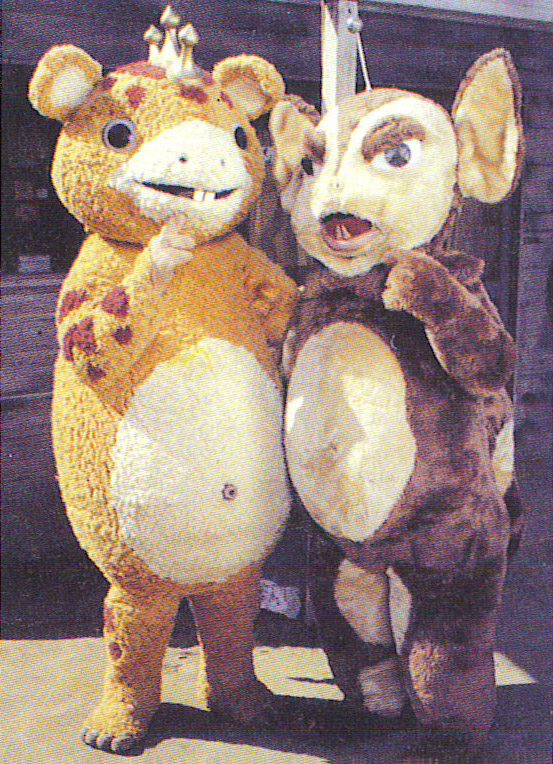 The friendly monsters Booska and Chamegon play hosts in the amusement park movie attraction. © 1969 Tsuburaya Productions Co., Ltd.
 Booska calls Ultraman and Ultra seven for help. © 1969 Tsuburaya Productions Co., Ltd.
 Poster for the RETURN OF ULTRAMAN mini movie. © 1971 Tsuburaya Productions Co., Ltd.
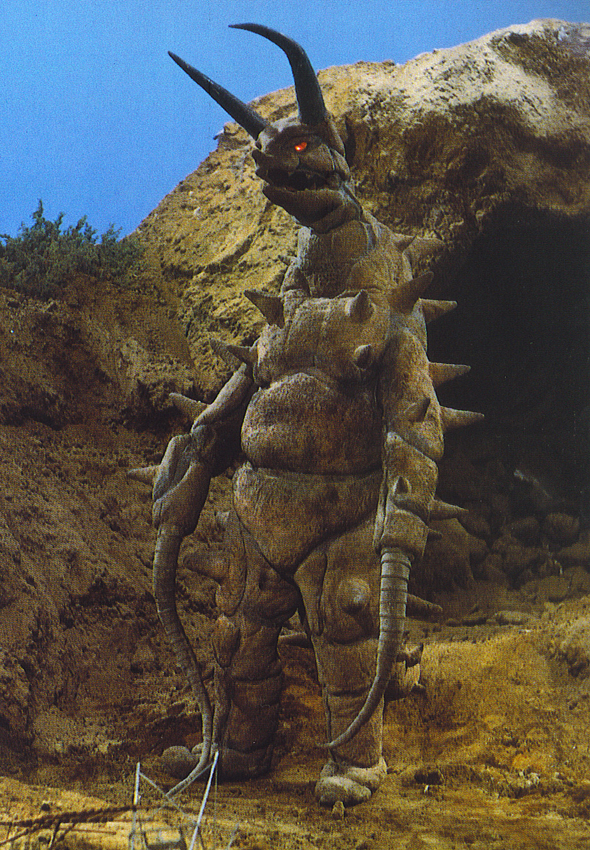 The giant monster Gudon. © 1971 Tsuburaya Productions Co., Ltd.
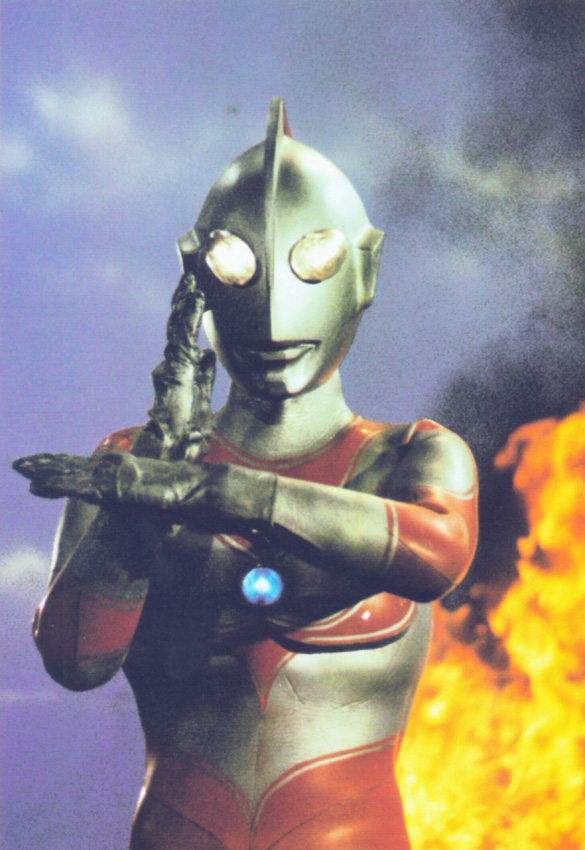 The Ultra Warrior from RETURN OF ULTRAMAN eventually became known as Ultraman Jack. © 1971 Tsuburaya Productions Co., Ltd.
 RETURN OF ULTRAMAN was part of the Toho Champion Festival for GODZILLA VS HEDORAH. © 1971 Toho Co., Ltd., Tsuburaya Productions Co., Ltd.
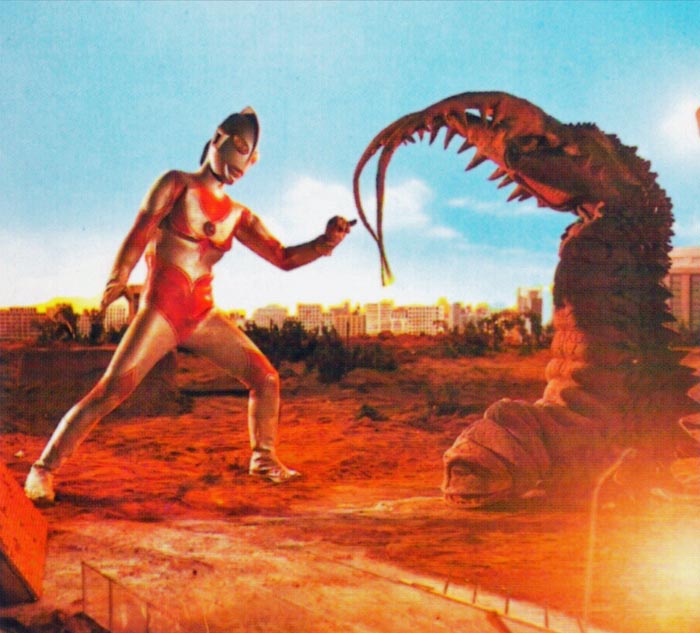 Ultraman Jack battles the monster Twintail. © 1971 Tsuburaya Productions Co., Ltd.
 Toho Champion Festival poster for RETURN OF ULTRAMAN: TERROR OF THE TORNADO MONSTER. © 1971 Tsuburaya Productions Co., Ltd.
 Ultraman Jack uses his powers to reverse a tidal wave. © 1971 Tsuburaya Productions Co., Ltd.
 Jack is stuck between the monstrous mates Seagorath and Seamons. © 1971 Tsuburaya Productions Co., Ltd.
 ULTRAMAN actor Akiji Kobayashi and monster suit performer Eiichi Kikuchi guest star in TERROR OF THE TORNADO MONSTER. © 1971 Tsuburaya Productions Co., Ltd.
 Toho Champion Festival poster with RETURN OF ULTRAMAN: RIDE THE MONSTER, JIRO! © 1972 Toho Co., Ltd., Tsuburaya Productions Co., Ltd.
 Jiro Sakata finds the lost space capsule. © 1971 Tsuburaya Productions Co., Ltd.
 The monster Yadokarin emerges from beneath the capsule. © 1971 Tsuburaya Productions Co., Ltd.
 Toho Champion Festival insert for ULTRAMAN TARO. © 1973 Tsuburaya Productions Co., Ltd.
 Astromons takes a pounding from Ultraman Taro. © 1973 Tsuburaya Productions Co., Ltd.
 The Mother of Ultra is like the sun. © 1973 Tsuburaya Productions Co., Ltd.
 SON OF GODZILLA Toho Champion Festival poster showing the complete festival lineup. © 1973 Toho Co., Ltd., Tsuburaya Productions Co., Ltd.
 Toho Champion Festival insert for ULTRAMAN TARO: BURN! SIX ULTRA BROTHERS! © 1973 Tsuburaya Productions Co., Ltd.
 Taro prepares to finish off Mururoa. © 1973 Tsuburaya Productions Co., Ltd.
 The origin of the Ultramen is revealed in a series of illustrations by Mamoru Uchiyama. © 1973 Tsuburaya Productions Co., Ltd.
 ULTRAMAN TARO: BURN! SIX ULTRA BROTHERS! was one of the co-features for the Toho Champion Festival re-release of KING KONG ESCAPES. © 1973 Toho Co., Ltd., Tsuburaya Productions Co., Ltd.
 The Ultra Series made a final Toho Champion Festival appearance when ULTRAMAN TARO: THE BLOODSUCKING FLOWER IS THE SPIRIT OF A LITTLE GIRL was shown as one of the co-features for GODZILLA VS MECHAGODZILLA. © 1974 Toho Co., Ltd. and Tsuburaya Productions Co., Ltd.
 Insert poster for ULTRAMAN TARO: THE BLOODSUCKING FLOWER IS THE SPIRIT OF A LITTLE GIRL. © 1974 TPC.
 A young girl has a strange connection to a blood-thirsty plant. © 1973 Tsuburaya Productions Co., Ltd.
 Basara electrocutes Taro. © 1973 Tsuburaya Productions Co., Ltd.